REVIEW · BUCHAREST
Half-Day Jewish Heritage Walking Tour in Bucharest
Book on Viator →Operated by Laura Genescu · Bookable on Viator
Synagogues tell Bucharest stories, block by block. This half-day walk gives you a guided Jewish heritage overview while you stay active, and the iPad photo storytelling helps you connect what you see now with what stood there before.
Two things I really like: the tight focus on key sites, and the way your guide can steer questions in the moment, from daily Jewish life to the bigger political shocks that shaped the community. One thing to plan for: the tour price may still require extra admission fees on top, so check what is covered for your exact stops and date.
Because this is a walking tour with multiple indoor visits, you should wear comfortable shoes and keep your expectations realistic for a 3 to 4 hour window in the morning. Also note it’s weather dependent, so have a flexible mindset if Bucharest decides to be stubborn outside.
In This Review
- Key Things That Make This Tour Worth Your Time
- A Half-Day Jewish Heritage Walk That Actually Makes the City Make Sense
- Price and Value for a Group of Up to 8
- Great Synagogue: 1845 to 1945, Told Through Architecture
- The Choral Temple: Vienna’s Influence and Local Bucharest Adaptations
- Jewish Museum: History of the Romanian Jewish Community in a WWII-Surviving Synagogue
- How the iPad Historical Photos Change the Walk (For Good)
- Timing, Meeting Point, and Getting There Without Stress
- Who Should Book This Jewish Heritage Tour—and Who Might Skip It
- The Booking Checklist I’d Use Before You Go
- FAQ
- How long is the Half-Day Jewish Heritage Walking Tour in Bucharest?
- What time does the tour start and where do we meet?
- Is this tour private, and how many people can be in a group?
- What language is the tour offered in?
- What are the main stops on the route?
- Is admission included in the price?
- What happens if the weather is poor?
- Should You Book This Jewish Heritage Walking Tour?
Key Things That Make This Tour Worth Your Time
- iPad historical photos help you “read” the buildings instead of just looking at them
- Private, small-group format (up to 8) means your guide can focus on your pace and questions
- Three major Jewish sites packed into a half day: synagogue, synagogue, then a Jewish community history museum
- A guide who can link past and present so the story lands as more than names and dates
- Recurring design layers at the Great Synagogue let architecture tell history in phases
- English-language narration with mobile ticket delivery for a smoother day
A Half-Day Jewish Heritage Walk That Actually Makes the City Make Sense
This is the kind of Bucharest tour that helps you get oriented fast. In just 3 to 4 hours at 9:30 am, you cover core Jewish landmarks and learn how the community shaped the city’s cultural map—and how history pushed and pulled that map again and again.
What makes it work for real travelers is that it is not only a lecture. You’re moving through neighborhoods, stopping at places that still exist, and pairing each stop with visual context from historical photos shown on an iPad. That combo matters. Without visuals, a synagogue’s name and date can feel like a trivia list. With the photos, you start noticing details—shape, style, damage, restoration—like you’re doing your own street-level interpretation.
And because it’s private for just your group, the guide can answer questions as they come up. Some groups have highlighted guides such as Jacky, Loan, and Laura for their ability to handle questions about the past, the present, and what comes next for Jewish life in Romania. That’s useful if you’re not just sightseeing—you want understanding.
You can also read our reviews of more walking tours in Bucharest


Price and Value for a Group of Up to 8
The tour is priced at $318.06 per group for up to 8 people. That sounds high if you’re thinking per person on day one, but value changes fast once you do the math with a small group.
- If you fill the group (8 people), the tour cost is about $40 per person for the guide and the full walking route.
- If you have fewer people, your per-person share rises, and that’s when the extra admission fees start to matter more.
About those admission fees: the details you’re given include a note that admission fees for synagogues and museums are $25 per person, and that admission to the Jewish state theater is not included. At the same time, the tour stops list admission tickets included for each of the three major sites. The practical takeaway is simple: budget around the $25 per person figure and confirm coverage for your date so you do not get surprised at the door.
Either way, you’re buying something that’s hard to replicate on your own: a focused route plus narration designed to connect the dots, including photo context. For many visitors, that’s a better use of a half day than trying to stitch together three stops independently with no story thread.
One more value clue: the experience is commonly booked about 65 days in advance, which suggests people find the timing and format useful. If you’re traveling in peak season, you’ll want to lock in early.
Great Synagogue: 1845 to 1945, Told Through Architecture
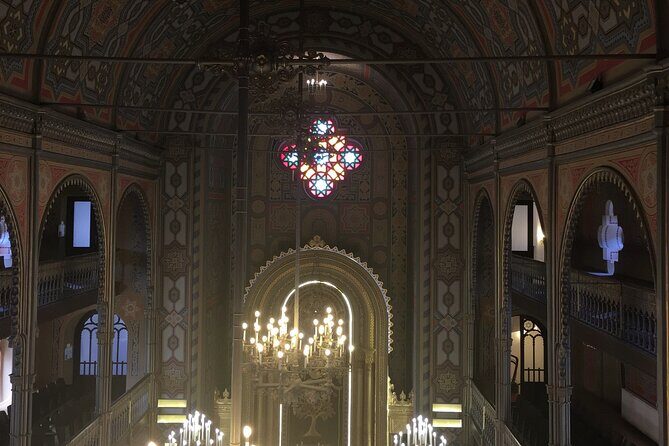
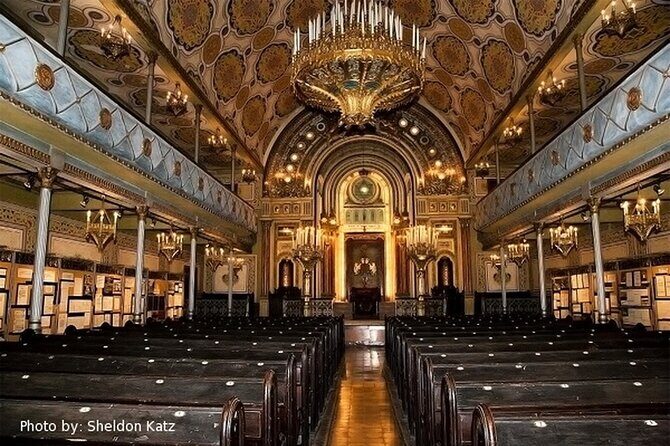
The Great Synagogue stop is the centerpiece, and it’s special because the building has lived through multiple redesigns and political blows. This isn’t a single-era monument—it’s a layered story you can see.
Here’s the timeline your guide will connect to the physical space:
- Raised in 1845 by the Polish-Jewish community
- Repaired in 1865
- Redesigned in 1903 and 1909
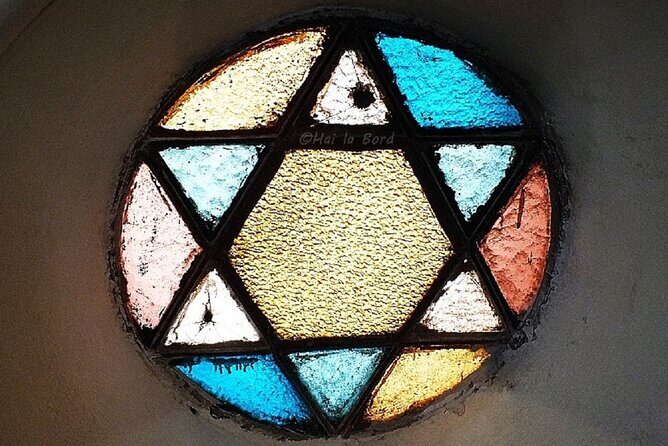
- Repainted in Rococo style in 1936 by Ghershon Horowitz
- Restored again in 1945 after devastation caused by the far-right Legionnaires (the Iron Guard movement)
Why this matters for you: a building like this is a record of Jewish community resilience and changing tastes, not just faith. When you hear about Rococo style, for example, you’re not expected to become an art historian—you’re meant to notice that Jewish identity here was part of wider European artistic currents too. And when the restoration after 1945 comes up, it shifts the conversation from architecture to survival and rebuilding.
Practical expectations for the stop:
- Time is around 20 minutes
- Admission is listed for this stop, though you should still confirm whether you’ll face any extra fees depending on what’s included for your booking
- You’ll likely be using the iPad photos to compare older views with the current look, which helps you spot the “before and after” feeling that’s hard to catch with only your eyes
The Choral Temple: Vienna’s Influence and Local Bucharest Adaptations
Next comes the Choral Temple, and this stop adds another angle: how ideas traveled. It’s not just about Bucharest building its own identity—it’s about Bucharest borrowing, copying, and adapting.
Key facts your guide will frame for you:
- Built between 1864 and 1866
- Designed by Enderle and Freiwald
- Described as a very close copy of Vienna’s Leopoldstadt-Tempelgasse Great Synagogue (built 1855–1858)
That Vienna connection is more than trivia. It helps you understand how communities—Jewish communities included—shared models across borders. You start realizing that architecture can act like a cultural language: the same grammar, different accent.
What you’ll probably notice during your visit:
- The stop is about 30 minutes, so you get a bit more time to take it in without feeling rushed
- The story tends to work best if you let the guide slow you down on what makes it a copy and what makes it local. Even small differences can signal different priorities or different contexts.
If you love comparative history—how cities influence each other—this is one of the most satisfying stops of the walk.
Jewish Museum: History of the Romanian Jewish Community in a WWII-Surviving Synagogue
The museum stop is built around a powerful survival detail: it’s located in the former Templul Unirea Sfântă synagogue, which survived World War II.
You may see the museum described with a few naming variants, including:
- Museum of the History of the Romanian Jewish Community
Why I like this part of the tour: it moves you from building-based history to community-based history. Synagogues are important, but a museum gives you the chance to slow down and absorb how people lived—how they organized, how they responded to upheaval, and how their story is told today.
This stop is about 20 minutes, which is enough time to:
- Orient yourself to what the museum covers
- Use your guide’s narration to understand why the former synagogue setting matters
- Catch the main themes without turning your morning into a multi-hour museum marathon
And because the tour includes historical photos on an iPad, the museum visit often feels like it’s connected back to the street-level story. That is exactly what you want from a half-day format: continuity, not disconnected stops.
You can also read our reviews of more historical tours in Bucharest





How the iPad Historical Photos Change the Walk (For Good)

Lots of tours say they show photos. This one actually uses them as a way to interpret the city. When historical photos appear during the walk, they do a few useful things:
- They reduce guesswork. You see what the guide is describing, instead of trying to picture it yourself.
- They make restoration and damage feel real. Talking about 1936 repainting or 1945 restoration lands better when you can compare eras visually.
- They help you ask better questions. Once you’ve seen the before-and-after idea, your curiosity shifts from Who? to How did it change?
The best guides on this route also tend to connect the photos to broader questions, including what Jewish life was like then and what it looks like now. Some groups have praised guides like Loan and Laura for answering questions on past, present, and future Jewish life in Romania, and for doing it with patience and candor.
If you’re the type of traveler who likes to know the story behind the façade, the photo approach is one of the tour’s strongest practical advantages.
Timing, Meeting Point, and Getting There Without Stress

You start at 9:30 am and the tour ends back at the meeting point. The meeting address is Starbucks, Str. Franceză 62, București.
A few practical notes that help you enjoy the morning:
- It’s described as near public transportation, so you can likely keep your commute simple.
- The walk is half-day length, so you’ll want to arrive with enough energy for moving between stops and spending time indoors.
- It requires good weather, meaning a bad day could lead to date changes or refunds.
Also, since private transportation or hotel pickup is not included, plan to get yourself to the meeting point on your own. That’s normal for many city walking tours, but it’s worth planning early so you’re not scrambling at 9:10 am.
Who Should Book This Jewish Heritage Tour—and Who Might Skip It
This is a great fit if you:
- Want a focused introduction to Jewish heritage in Bucharest without spending a whole day
- Like walking tours but still want indoor stops with real context
- Appreciate history that includes the human side—community life, questions, and changing circumstances—rather than only dates
- Travel with a small group and want your guide to stay tuned to your pace
You might consider skipping or comparing if you:
- Prefer a self-guided pace and do not want narration-led transitions
- Are mainly chasing a long museum experience rather than a route-based overview
- Really dislike paying extra at the door. Because the information you’re given includes a note about admission fees, you’ll want to confirm what’s fully covered.
For most visitors, though, this kind of route is exactly the “best first step” that helps you enjoy the rest of Bucharest more fully.
The Booking Checklist I’d Use Before You Go
To keep things smooth, I’d double-check these items when you reserve:
- The tour is English-language and you’ll get a mobile ticket
- It’s private for your group, with a maximum of 8 people
- Expect 3 to 4 hours total, starting at 9:30 am
- Confirm whether any admission fees (listed as $25 per person) are due for your exact stops and whether the Jewish state theater is part of your day
- Wear shoes you’re comfortable walking in, since it’s still a walking tour
- Keep weather in mind, since the experience requires good conditions
FAQ
How long is the Half-Day Jewish Heritage Walking Tour in Bucharest?
It lasts about 3 to 4 hours.
What time does the tour start and where do we meet?
It starts at 9:30 am at Starbucks, Str. Franceză 62, București.
Is this tour private, and how many people can be in a group?
Yes. It’s a private experience with only your group participating, and the group size is up to 8 people.
What language is the tour offered in?
The tour is offered in English.
What are the main stops on the route?
The tour visits the Great Synagogue, the Choral Temple, and the Museum of History of the Jewish Community.
Is admission included in the price?
The details provided include that admission tickets are listed as included for the main three stops, but there is also a note that admission fees for synagogues and museums are $25 per person, and that admission to the Jewish state theater is not included. Confirm what’s covered for your exact booking.
What happens if the weather is poor?
If the tour is canceled due to poor weather, you’ll be offered a different date or a full refund.
Should You Book This Jewish Heritage Walking Tour?
I’d book it if you want a smart, half-day way to understand Jewish heritage in Bucharest without turning your trip into a research project. The combination of a small private group, historical photos on an iPad, and three high-impact stops makes it easier to connect the city’s architecture to real history.
Just do one thing before you go: confirm admission coverage for your date, since the provided details include both included-tickets notes and a separate $25 per person admission fee note. If you’re good with that small planning step, this is the kind of tour that can make Bucharest feel personal and understandable instead of just scenic.