REVIEW · BUCHAREST
Bucharest: private and exclusive Italian walking tour
Book on GetYourGuide →Operated by S.C. VIAGGIARE BUCAREST S.R.L. · Bookable on GetYourGuide
Bucharest tells better stories in Italian. This private 2.5-hour walk is built around flexibility, so you move at your pace while an experienced Italian certified guide connects architecture to real human events. I like that the route mixes the famous parts with quieter corners that many people miss, and I also like how the guide can slow down (or speed up) depending on your questions and interests. One caution: the tour is Italian-only, and it’s noted as not suitable for hearing-impaired visitors.
The big wins are how smoothly the tour balances landmarks with side stories, and how well the guide can adjust when conditions get tough (even rain). In particular, the feedback highlights guides like Filippo Dicataldo and Giuseppe as especially strong at giving precise explanations and keeping things engaging. The only drawback to plan around is that you’ll still be walking outdoors for about 2.5 hours, so it may not feel comfortable if you have mobility limits, even though it’s listed as wheelchair accessible.
In This Review
- Key highlights worth your attention
- Why this Italian walking format works in Bucharest
- Starting at Caru’ cu Bere: orientation with a story attached
- Old Town around Lipscani: monasteries, inns, and street-level history
- Stavropoleos Orthodox Monastery
- Manuc’s Inn (Hanul lui Manuc)
- A quick round of Old Town landmarks and viewpoints
- Pasajul Villacrosse and the National Bank: the city gets official
- The National Bank of Romania facade
- Pasajul Villacrosse
- Calea Victoriei: elegant buildings and a sense of momentum
- Umbrellas Street and Cărturești Carusel: playful visuals, smart placement
- Cărturești Carusel photo stop
- The Umbrellas Street photo stop
- Revolution Square and the Romanian Athenaeum: where Bucharest’s turning points show
- Revolution Square
- Romanian Athenaeum
- Price and logistics: is $53 a good deal?
- Who this tour fits best (and who might skip it)
- My booking call: should you book this Italian walking tour?
- FAQ
- Is the Bucharest: private and exclusive Italian walking tour really private?
- How long is the tour?
- What language is the tour guide?
- Where does the tour start?
- Which places are included on the route?
- Is the tour wheelchair accessible?
- Is it suitable for people with mobility impairments?
- Is it suitable for hearing-impaired people?
- What is included in the price?
- Is food included?
Key highlights worth your attention

- Italian private tour with a certified guide, tailored to your pace
- Old Town focus around Lipscani Street and nearby historic sites
- Calea Victoriei walk for elegant architecture and period details
- Revolution Square + Romanian Athenaeum for modern Romanian turning points
- Photo stops that make Bucharest’s visual quirks easy to catch
- Small, controlled route that keeps the story coherent without rushing
Why this Italian walking format works in Bucharest
Bucharest can feel like a city with two faces. You get the grand, formal look of the boulevards and institutions, and then you turn a corner and suddenly you’re in older neighborhoods with monastery walls, old inns, and streets that still feel like they’re remembering. This tour leans into that contrast on purpose. You’re not just ticking off sights; you’re learning how the city’s layers fit together.
The private setup matters more than you might think. When a guide can respond to your pace, you don’t have to sprint between highlights. You can pause for a better view, ask one extra question about a building you find interesting, or spend a little longer near a place that sparks curiosity. That flexibility is exactly what makes a short 2.5-hour walk feel longer and more satisfying.
And yes, language matters too. With Italian-only guiding, you’ll get the kind of detailed storytelling that works best when you can follow every nuance. If you speak Italian, this is one of those rare tours where the language feels like a feature, not a limitation.
You can also read our reviews of more walking tours in Bucharest


Starting at Caru’ cu Bere: orientation with a story attached
Your meeting point is in front of Caru’ cu Bere on Stavropoleos Street 5. This is a good starting move because it puts you in the Old Town zone right away, where Bucharest’s atmosphere is at its most tactile: close streets, layered architecture, and that sense of the city living in layers of time.
The tour gives you a short guided introduction connected to Caru’ cu Bere itself. Even if you don’t go inside, you’ll understand why this kind of place matters in the bigger picture. In Bucharest, restaurants like this aren’t only about food; they’re part of the social history of the neighborhood.
A practical tip: if you’re coming in from farther away, arrive a few minutes early and take 30 seconds to look around. The streets here change character fast, and getting your bearings early makes everything that follows easier to enjoy.
Old Town around Lipscani: monasteries, inns, and street-level history
After the first orientation, the walk spends time in the Historic Old Town area, including the neighborhood famously associated with Lipscani Street. Lipscani is known for nightlife, but on this route you’ll see how it also holds important architecture and religious heritage nearby. That mix is the point: Bucharest doesn’t separate fun from history. It stacks them.
Stavropoleos Orthodox Monastery
One of the early highlights is Stavropoleos Monastery. You’ll get time for a guided visit rather than a quick glance. This is the kind of stop where good narration changes what you notice: details in stonework, the monastery’s place in the neighborhood, and why it survives in a city that keeps changing.
Manuc’s Inn (Hanul lui Manuc)
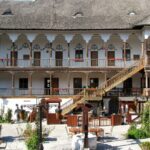
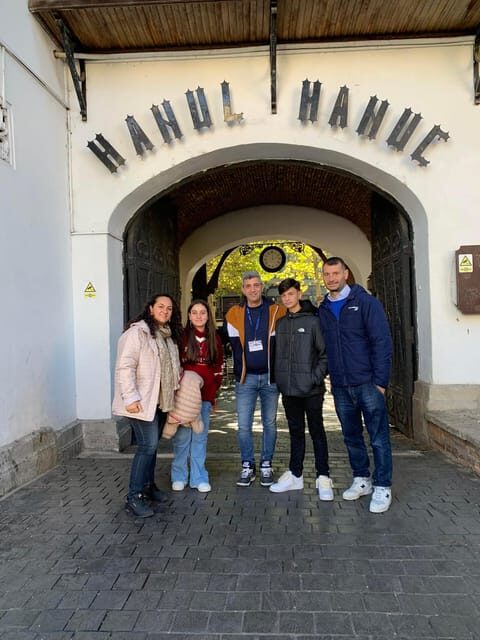
Then you shift to Manuc’s Inn, a historic building that connects to Bucharest’s past as a crossroads where travelers, trade, and stories passed through. It’s not just a pretty facade on a street corner. With a strong guide, it becomes a clue about how the city functioned before modern Romania looked the way you see today.
You can also read our reviews of more private tours in Bucharest




A quick round of Old Town landmarks and viewpoints
The route also includes brief guided moments around other Old Town details, keeping the walk varied. You’re not sitting through long museum-style pauses. Instead, you get just enough time at each place to understand what you’re looking at, then move on with momentum.
A small consideration: because this is an Old Town walking section, expect uneven pavements and lots of standing and close looking. Comfortable shoes are not optional here.
Pasajul Villacrosse and the National Bank: the city gets official
Bucharest has a habit of mixing grand institutions with surprisingly personal street life. This tour uses that rhythm well.
The National Bank of Romania facade
You’ll have a guided visit at the National Bank of Romania. The value here is in the explanation: why certain buildings look the way they do, what they signal about state identity, and how Bucharest’s architecture reflects national ambitions across different periods.
Pasajul Villacrosse
Next is Pasajul Villacrosse, a passage you’ll appreciate more if you treat it like a mini time capsule. Passages like this aren’t only about design; they show how people moved through the city and how commerce shaped everyday life. In a short walk, this stop works as a satisfying reset between bigger landmarks.
If you like photography, keep your phone or camera accessible here. These passageways and institutional buildings can look better from the “right” angle than from the front door view.
Calea Victoriei: elegant buildings and a sense of momentum
Then you head to Calea Victoriei, often described (fairly) as Bucharest’s most elegant boulevard. On this part of the tour, the vibe changes. The streets get wider and the architecture starts speaking a different language: formality, power, and a cleaner line between public buildings and the city’s desired image.
You get a guided walk here with time to take it in. What I like about this section is that it doesn’t feel like a generic boulevard stroll. A good guide turns the buildings into clues: what era they represent, how style signals authority, and how the boulevard’s role evolved.
It’s also a practical breather. After the tighter Old Town streets, the wider boulevard gives your legs a bit of space and your eyes a cleaner view to connect the story you’ve already heard.
Umbrellas Street and Cărturești Carusel: playful visuals, smart placement
Bucharest loves visual quirks, and the tour includes two that work well as quick stops.
Cărturești Carusel photo stop
You’ll have time at Cărturești Carusel for photos. If you enjoy places where culture shows up in unexpected forms, this is a good moment to capture the look without spending a long time inside.
The Umbrellas Street photo stop
Then comes Umbrellas Street, another photo-focused stop. This isn’t about facts the way the monasteries or the square are. It’s more about understanding how Bucharest’s newer storytelling layers sit over older streets. If you’re the type who likes to remember the city visually, don’t skip this section.
Quick tip: if it’s raining (or about to rain), these are the moments you’ll care most about your camera settings. The umbrellas and the reflections can look great, but you don’t want to fumble while you’re holding wet gear.
Revolution Square and the Romanian Athenaeum: where Bucharest’s turning points show
The tour saves one of its strongest emotional clusters for the end phase: Revolution Square and the Romanian Athenaeum.
Revolution Square
At Revolution Square, you’ll get a guided explanation of the end of Ceausescu’s dictatorial regime in December 1989. This is exactly where the city’s past and future collide. The surrounding buildings look beautiful, but you’ll learn to read them as witnesses to different periods of Romanian history.
One practical advantage of having a guide here: history-heavy squares can feel abstract if you’re on your own. With narration, you understand why the space matters and how it connects to what came after.
Romanian Athenaeum
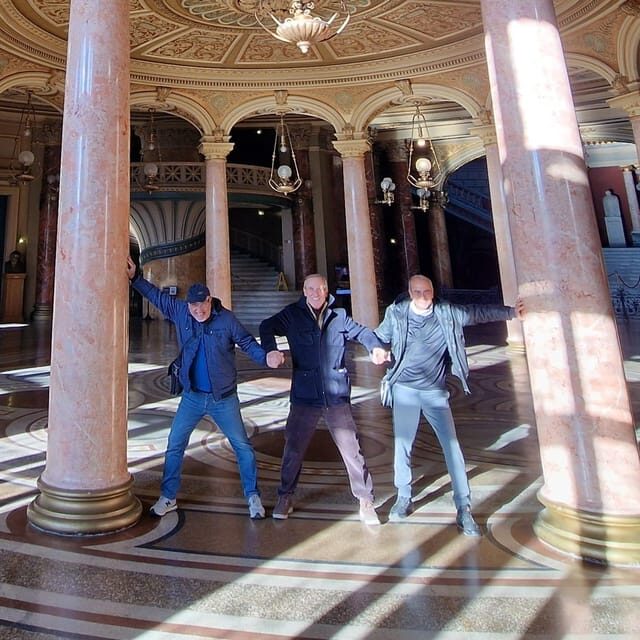
Then you’ll visit the Romanian Athenaeum for guided time. The guide’s job at this point is crucial because the Athenaeum isn’t only an attractive landmark. It’s a cultural signal, and it makes sense as part of the tour’s broader theme: Bucharest as a city that keeps re-defining itself.
This pairing works because it moves from political turning point to cultural identity within the same walk. Even in a short time, you leave with a clearer sense of what Romania values and how that shows up in architecture.
Price and logistics: is $53 a good deal?
At $53 per person for about 2.5 hours, this is priced in the “serious value” zone for a private guided tour. The big reason is the format: you’re not sharing your guide with a large group, and you’re getting a certified tour guide in Italian.
Now, the math you should do is simple: compare the per-person cost of this private plan versus the cost of joining larger tours. If you’re traveling as a couple or small group, private walking tours often end up being surprisingly reasonable when you split the experience between fewer people. If you’re traveling solo, it’s still a strong option if you’re committed to Italian storytelling and prefer a paced, question-friendly walk.
Also keep your expectations calibrated. This isn’t a multi-day deep research project. It’s a compact route designed for understanding. If you want a lot of museum time, you’ll need to add that separately. But for getting your bearings and building context quickly, this price feels fair.
Who this tour fits best (and who might skip it)
This is a great fit if you:
- Speak or understand Italian and want detailed narration
- Like walking tours where the guide explains what you’re seeing, not just where to stand
- Want a route that connects Old Town + boulevards + political/cultural sites in one loop
- Enjoy photo-friendly stops without turning the day into a sightseeing sprint
It may not be the best fit if you:
- Need accommodations for hearing impairment, since it’s noted as not suitable for hearing-impaired people
- Have mobility limitations that make a 2.5-hour walk tough, even though it’s listed as wheelchair accessible
- Want food included, since food and beverages aren’t included
My booking call: should you book this Italian walking tour?
Yes, you should book if Italian is your working language and you want a well-paced introduction to Bucharest that goes beyond surface facts. The route gives you a strong mix: monasteries and inns in Old Town, the elegance of Calea Victoriei, and the emotional weight of Revolution Square plus the cultural anchor of the Romanian Athenaeum. That combination is hard to replicate well on your own in just a couple hours.
I’d also book it if you care about the guide’s quality. Feedback repeatedly flags guides like Filippo Dicataldo and Giuseppe for precise explanations and strong storytelling, even when weather gets unpleasant. That kind of guide skill is what turns a walking tour from walking into learning.
If you’re unsure, do the simplest test: check that you’re comfortable with an Italian-only tour and that the time on your feet works for you. If those boxes are checked, this is a smart, focused way to get real context fast.
FAQ
Is the Bucharest: private and exclusive Italian walking tour really private?
Yes. It’s described as a private group tour, and it’s private and exclusive.
How long is the tour?
The duration is 2.5 hours.
What language is the tour guide?
The live tour guide speaks Italian.
Where does the tour start?
The guide meets you in front of Caru cu Bere at Stavropoleos Street 5.
Which places are included on the route?
The tour covers key Bucharest areas including Old Town (Lipscani area), Calea Victoriei, and Revolution Square, plus stops such as Stavropoleos Monastery, Manuc’s Inn, the National Bank, Pasajul Villacrosse, Umbrellas Street, and the Romanian Athenaeum.
Is the tour wheelchair accessible?
It’s listed as wheelchair accessible.
Is it suitable for people with mobility impairments?
It’s noted as not suitable for people with mobility impairments.
Is it suitable for hearing-impaired people?
It’s noted as not suitable for hearing-impaired people.
What is included in the price?
You get a private and exclusive tour in Italian with a certified tour guide in Italian.
Is food included?
No. Food and beverages are not included, and you’ll want to plan accordingly.