REVIEW · BUCHAREST
Bucharest Unveiled: A Private Walking Journey
Book on Viator →Operated by Crafted Tours Romania · Bookable on Viator
A city needs a first good walk. This private Bucharest tour gives you clear bearings fast, with a professional guide narrating what you’re seeing and why it matters. You pick a day or evening time, and then you follow a smart route that mixes monuments, architecture, and the places where modern Romania’s story turns.
I like that the stops are short, focused, and ticket-free (so you don’t lose the pace hunting for entry lines). And I really value the guide component: people mention standout guides like Manuela and Toni for strong storytelling and helpful answers, plus practical ideas for what to do next in the city.
One thing to consider: this is weather-dependent. If conditions are rough, the tour may be moved or refunded, so plan to pack a rain layer and stay flexible.
In This Review
- Key highlights worth your attention
- Price and walking value on a $57.67 private tour
- Private guide momentum: a tour you can actually control
- When to schedule: day vs evening pacing in Bucharest
- Stop 1: Romanian Atheneum and why it feels like a temple
- Stop 2: Piata Revolutiei and the 1989 Revolution scene
- Stop 3: Calea Victoriei’s major monuments along the boulevard
- Stop 4: Central University Library and Carol I’s equestrian statue
- Stop 5: Royal Palace exterior and the Maria/Carol II era
- Stop 6: Old Town walking section with café-and-architecture energy
- Stop 7: Stavropoleos Monastery—one quiet corner in the middle
- Palace of the Parliament: the numbers that actually help
- National Theatre and the big-square moments between monuments
- The guides: what you’ll feel in the narration
- What to bring so the walk feels easy
- Should you book Bucharest Unveiled?
- FAQ
- FAQ
- How long is the Bucharest Unveiled walking tour?
- What does the tour cost?
- Is the tour private or shared?
- What language is the guide speaking?
- Where does the tour start?
- Does the tour include pickup?
- Are entrance fees included?
- What if the weather is bad?
- Is there free cancellation?
Key highlights worth your attention
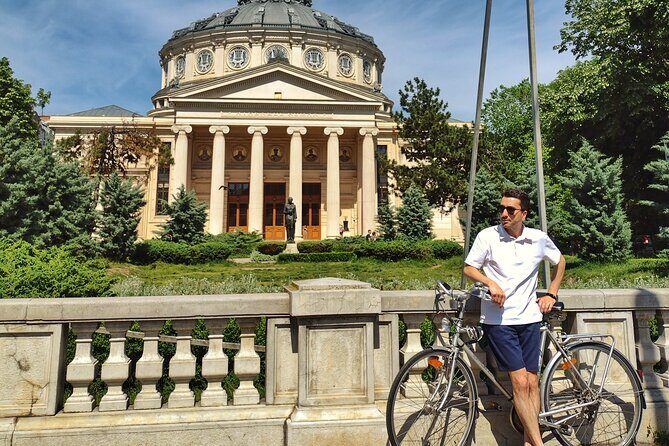
- Romanian Atheneum as your first landmark: temple-like exterior views that snap the city into focus.
- Piata Revolutiei’s 1989 context: you’ll get the Revolution-era story tied to the place where Ceausescu gave his last speech.
- Elegant Calea Victoriei boulevard walk: major buildings and monuments along one of Bucharest’s showiest avenues.
- Carol I and the Central University Library area: architecture plus the equestrian statue you can spot from the walk.
- Old Town + Stavropoleos Monastery in one stretch: two different time layers without extra transit.
- Palace of the Parliament scale explained: big, numeric comparisons to help it actually make sense.
Price and walking value on a $57.67 private tour
For about $57.67 per person, you’re not just buying a route on a map. You’re paying for a certified guide who will narrate as you walk, which is the difference between seeing buildings and understanding them. With a private format, you also get a more natural pace—less waiting around for other people and more chances to ask questions.
The other value hook is that the itinerary is built around no-ticket stops. The Romanian Atheneum, Piata Revolutiei, Calea Victoriei, the Central University Library area, the Royal Palace exterior, Old Town, Stavropoleos Monastery, and the Parliament exterior are all listed as admission ticket free. You can spend your time looking and listening instead of budgeting time for ticketing.
The tour runs roughly 2 to 3 hours. That’s a good window for first-time orientation, but it also means each stop is a “see it and get the story” moment rather than an all-day deep session.
You can also read our reviews of more walking tours in Bucharest


Private guide momentum: a tour you can actually control
This is a private walking experience, so it’s just your group. That matters more than people think in Bucharest, where neighborhoods and landmarks can feel spread out. A guide can slow down for photos, speed up if you’re eager, and tailor the emphasis to what you care about most.
Pickup is offered, which can help if you’re arriving with jet lag or you just don’t want to think about transit before your first walk. Even if you don’t use pickup, the start point is near public transportation, so it’s not a pain to reach.
If you’re traveling with someone who hates crowds, the private setup is a relief. You’ll still get the energy of central Bucharest, but without the feeling of being swept along with strangers.
When to schedule: day vs evening pacing in Bucharest
The tour offers both day and evening timings. For me, the practical choice is simple: if you’re here for a first look and photo set, morning or early afternoon often makes landmark exteriors easier to read. If you want atmosphere and softer light for squares and broad avenues, evening can work well.
One real-world note: because the experience requires good weather, you should plan for a backup. If you know your schedule is tight, having a second option in mind for your first day helps.
Stop 1: Romanian Atheneum and why it feels like a temple
You start at Ateneul Roman, the Romanian Atheneum. This building is described as resembling an ancient Greek temple, and even without getting technical, that detail tells you how Bucharest wanted to position itself—serious, cultured, and European-looking.
Because it’s only about 15 minutes, you’re not there to memorize facts. You’re there to orient. The guide’s narration should help you spot the visual language of the building and connect it to the rest of your walk.
If you like architecture that signals ambition—cities that wanted to look bigger than their age—this stop gives you that mindset right away.
Stop 2: Piata Revolutiei and the 1989 Revolution scene
Next is Piaka Revolukiei (Piata Revolutiei). This is the place where former communist president Ceausescu had his last speech in 1989. The tour includes pictures and video presentations from Revolution days, which is a smart way to make the location feel real instead of abstract.
This stop lasts about 45 minutes, longer than most. That extra time usually matters here. You need a little emotional and historical context to understand why the square isn’t just a traffic hub—it’s a turning point.
Practical tip: if you’re the type who likes to ask follow-up questions, this is the moment to do it. The guide can connect the square to Romania’s shift after the Revolution and explain how politics reshaped what you see around you.
You can also read our reviews of more private tours in Bucharest



Stop 3: Calea Victoriei’s major monuments along the boulevard
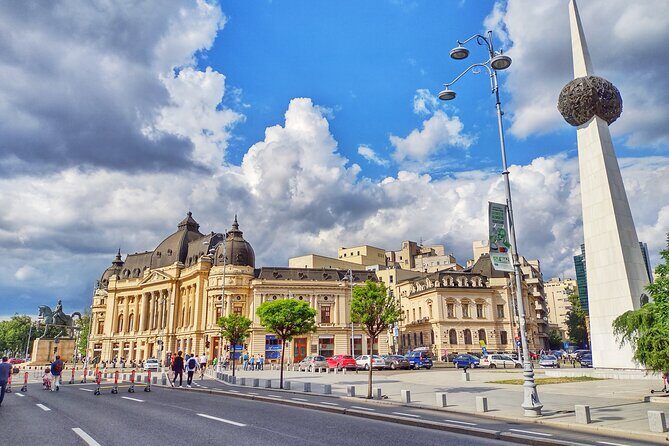
Calea Victoriei is one of Bucharest’s most elegant avenues. It’s also a street where monuments, major buildings, and civic symbolism are packed into a walking-friendly stretch.
This part runs about 30 minutes, and that time is usually enough to get a sense of the boulevard’s “big-city” character. The guide’s narration helps you pick up what matters: where power is displayed, how different eras left their mark, and which buildings are landmarks for a reason.
A small drawback: because boulevard walks can cover ground, you’ll want comfortable shoes. If you rush, you’ll miss details. If you slow down with the guide, you’ll start noticing the patterns that make Bucharest feel like a layered capital rather than a random collection of sights.
Stop 4: Central University Library and Carol I’s equestrian statue
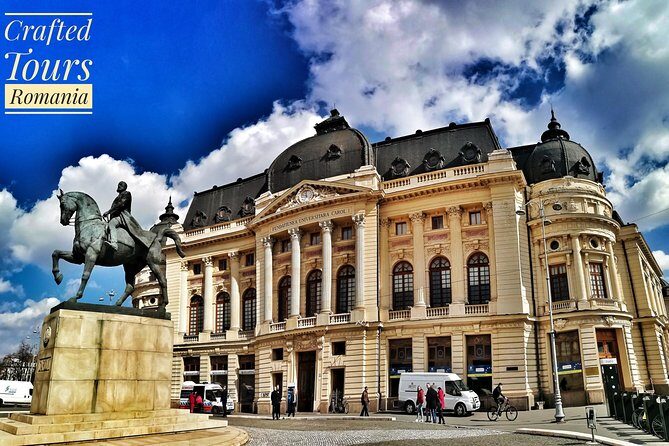
The Central University Library stop is brief—about 10 minutes—but it’s built for recognition. The library is described as eclectic style, built by French architect Paul Gottereau with sponsorship linked to King Carol I.
Outside is where a lot of the “story payoff” happens, especially with the equestrian statue of Carol I you can see in front of the library. This is the kind of detail a good guide turns into an anchor point for everything else you’ll see.
If you’re the type who likes to understand the people behind buildings, this short stop tends to be satisfying because it connects architecture to real decision-makers.
Stop 5: Royal Palace exterior and the Maria/Carol II era
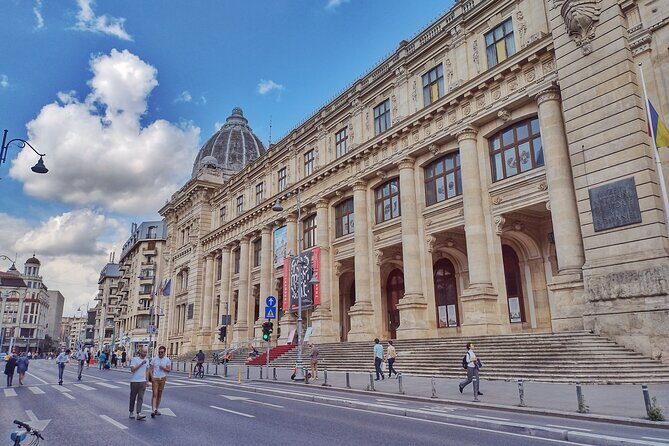
Palatul Regal, the Royal Palace, is part of the route for about 10 minutes. It’s described as the winter residence of Romanian kings and dated to 1937. The tour notes that the palace was built under the supervision of Queen Maria and her son, King Carol II.
Even without entry, the exterior can communicate a lot: scale, formality, and the message of monarchy in the capital. The guide’s narration helps you connect the style to the era and to why the monarchy wanted such visible presence.
If you’re hoping for a long sit-down history lesson, this won’t be that. But for orientation—and for getting the “who/when/why” behind the look—it works well.
Stop 6: Old Town walking section with café-and-architecture energy
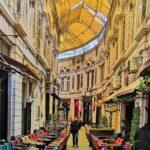
You then move into Old Town for about 30 minutes. This is the part where Bucharest feels lived-in: cafes, pubs, and restaurants sit alongside 19th-century architecture.
I like this stop because it breaks the monument-only rhythm. You’re not only seeing the grand symbols; you’re also seeing how the streets operate now. That matters because it helps you picture where you’d actually spend time after the tour.
If you’re sensitive to crowds or street noise, just know the Old Town center can be active. It’s not a quiet museum lane; it’s part of the city’s everyday life.
Stop 7: Stavropoleos Monastery—one quiet corner in the middle
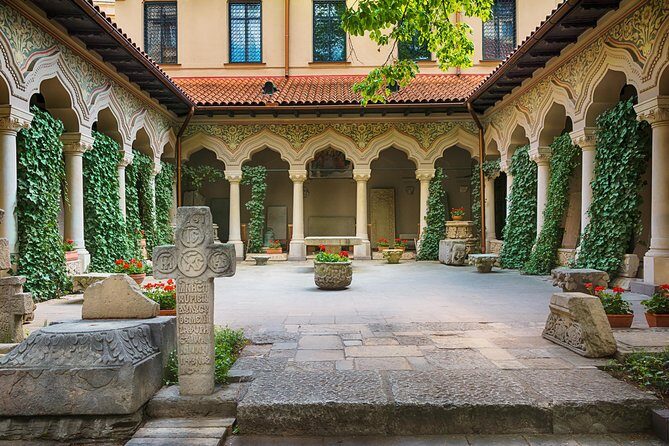
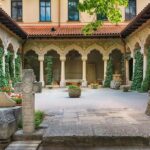
Stavropoleos Monastery is listed as about 15 minutes and described as a hidden gem in Old Town, one of the oldest churches in Bucharest dating from 1724.
This is the kind of stop that resets your brain. After broader avenues and grand facades, you get something smaller, older, and more intimate. If you enjoy religious architecture, or you just like seeing the city’s calmer side, this is a strong counterpoint.
Because you’re moving quickly, don’t try to cram it all in. Let the guide’s narration frame what you should notice, then take your own look for a few minutes.
Palace of the Parliament: the numbers that actually help
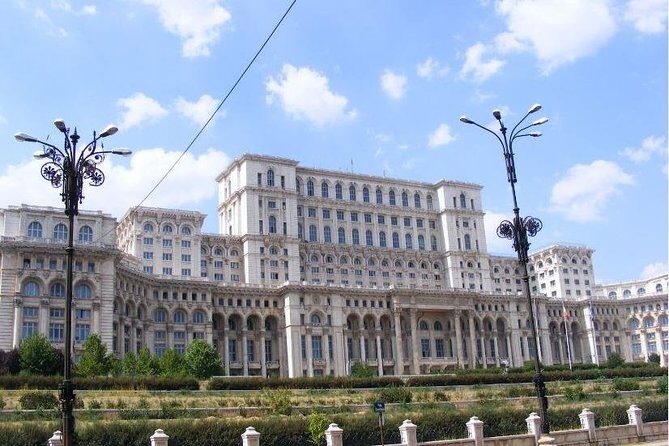
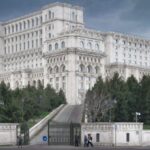
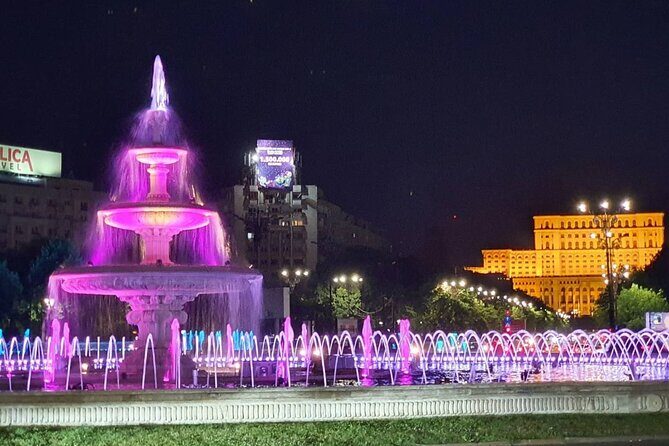
One of the most memorable parts is the exterior of the Palace of the Parliament. The tour explains that construction began in 1984, and that it’s described as the heaviest building in the world and the world’s third-largest administrative building.
The guide also uses a comparison that helps you visualize scale: the building exceeds the Great Pyramid of Giza in Egypt by 2% in volume. The tour describes it as labeled pharaonic construction, and even just hearing that term can make the building feel less like a random mega-project and more like a deliberate statement.
This stop is built for comprehension. With a structure this large, “huge” doesn’t mean much until you get a concrete framework. Narration is key here, because the exterior view alone can feel like a wall unless someone tells you what you’re looking at.
A practical consideration: it’s a photo stop, but you may want to pace yourself. Wide exteriors can make you walk a bit more than you expected.
National Theatre and the big-square moments between monuments
The last segments include the National Theatre in Bucharest and a main square surrounded by imposing statues and buildings. Those stops work as a closing rhythm: you go from the massive Parliament scale back to civic and cultural symbols—places where people gather, watch, and celebrate.
Even if you’re not a theatre person, the National Theatre area helps you understand Bucharest’s identity beyond politics and architecture. It’s a reminder that the city isn’t only about what was built for power; it’s also about where culture happens.
The square stop is short, but the point is recognition. You’ll leave knowing the kind of space Bucharest uses for public presence: statues, stone, and a strong sense of ceremony.
The guides: what you’ll feel in the narration
Two guide names show up in the experience feedback: Manuela and Toni. That’s useful because it signals the level of storytelling you should expect—history and architecture tied together, with clear answers when you ask questions.
Manuela is described as having comprehensive knowledge of Romanian history and architecture, plus giving practical ideas for restaurants, sights, and activities. Toni is praised for making the tour enjoyable and for being informative when answering questions, with specific enthusiasm for cultural landmarks such as the opera house area and the royal palace context.
You can use that as a cue for how to travel on this tour:
- bring your curiosity
- ask one or two questions you’re genuinely curious about
- be ready to swap your plans based on what the guide suggests
That’s where the tour tends to pay off, because you leave with a city-reading skill, not just photos.
What to bring so the walk feels easy
This tour is walking-based, and while the time per stop is short, the total movement adds up over 2 to 3 hours.
I’d show up with:
- comfortable shoes (Old Town streets and boulevard edges can be uneven)
- a light layer (weather can change fast)
- a rain jacket if forecasts look sketchy, since the tour depends on good weather
- your phone charged for the narration and video moments
If you’re planning to eat soon after, the guides’ practical suggestions can help you choose between a quick bite and a proper sit-down meal. Since food and drinks aren’t included, it’s smart to have a plan for the post-walk window.
Should you book Bucharest Unveiled?
If you’re in Bucharest for the first time and want a guided sense of direction, this is a strong pick. The route covers core landmarks, the narration gives context, and the private format makes it feel focused rather than chaotic.
I’d lean toward booking if:
- you want an overview that connects architecture to history
- you appreciate asking questions and getting direct answers
- you’d rather spend your time looking than paying entry fees (the stops listed are admission-free)
I’d think twice if:
- you need a lot of interior time inside buildings
- you’re traveling on days with questionable weather and can’t adjust
FAQ
FAQ
How long is the Bucharest Unveiled walking tour?
It lasts about 2 to 3 hours.
What does the tour cost?
The price is listed as $57.67 per person.
Is the tour private or shared?
It’s a private tour/activity, so only your group participates.
What language is the guide speaking?
The tour is offered in English.
Where does the tour start?
The start point is Strada Benjamin Franklin 4, București 030167, Romania.
Does the tour include pickup?
Pickup is offered.
Are entrance fees included?
No. Entrance fees are not included, though the listed stops are shown as admission ticket free.
What if the weather is bad?
The tour requires good weather. If it’s canceled due to poor weather, you’ll be offered a different date or a full refund.
Is there free cancellation?
Yes. You can cancel up to 24 hours in advance for a full refund.
If you want, tell me your travel dates and whether you prefer a day or evening start, and I’ll suggest what kind of companion landmarks you can pair this walk with afterward.