REVIEW · BUCHAREST
Bucharest: Romanian Athenaeum Guided Tour
Book on GetYourGuide →Operated by Iana Bradu Art SRL · Bookable on GetYourGuide
Music history in one breathtaking hall. This private visit to the Romanian Athenaeum turns neoclassical architecture into a clear story of national identity, starting with the six Ionic columns on the façade. I also like the way the guide walks you through Costin Petrescu’s 1930s panoramic fresco scene by scene, from Roman times through the Great Union of 1918.
You’ll spend time inside the concert hall itself, not just outside posing for photos. The main drawback: it’s a tight 1.5–2 hour tour, so if you’re hoping for a long, concert-length sit-down or guaranteed orchestra rehearsal time, plan a separate evening at the hall.
In This Review
- Key highlights you’ll actually notice
- Meeting Iana at the Artists’ Entrance (and why timing matters)
- Façade First: the Ionic columns and the money story behind the building
- Inside the circular vestibule: marble, light, and the acoustics clue
- The horseshoe concert hall: why nearly 800 seats feels intimate
- Costin Petrescu’s panoramic fresco: Romanian history as a visual map
- George Enescu Philharmonic: the Athenaeum as a living cultural machine
- Extra context you might catch: communism, art changes, and rehearsal moments
- Photo rules and practical tips for getting your best shots
- Price and value: what $44 buys (and what it does not)
- Who should book this tour (and who might feel rushed)
- Should you book the Romanian Athenaeum guided tour?
- FAQ
- How long is the Romanian Athenaeum guided tour?
- How much does the tour cost?
- Is this tour private or small-group?
- What languages are available?
- Where do I meet the guide?
- Can I take photos inside?
- Is flash photography allowed?
- Who is the tour suitable for?
- What should I bring?
- Is there free cancellation?
Key highlights you’ll actually notice
- Six Ionic columns with ancient Greek temple symbolism (wisdom, balance, artistic spirit) right at the entrance
- The Give a leu for the Athenaeum campaign and the 19th-century push that helped fund the building
- Circular vestibule and dome acoustics that make the inside feel purposeful, not just pretty
- Horseshoe-shaped seating for nearly 800 people, designed for sound and architectural harmony
- Costin Petrescu’s panoramic fresco with a full sweep of Romanian history
- George Enescu Philharmonic context on how the Athenaeum functions as a cultural anchor
Meeting Iana at the Artists’ Entrance (and why timing matters)
You’ll meet Iana at the side entrance on the right, just beside the front steps of the Romanian Athenaeum. This is the artists’ entrance, which helps the tour feel more grounded than a generic “meet out front” situation.
The whole tour runs about 1.5–2 hours, so you’ll want to arrive a few minutes early. That little buffer matters here because you’re going in with a plan: architecture first, then the hall, then the fresco, then the cultural story behind it all.
You can also read our reviews of more guided tours in Bucharest



Façade First: the Ionic columns and the money story behind the building
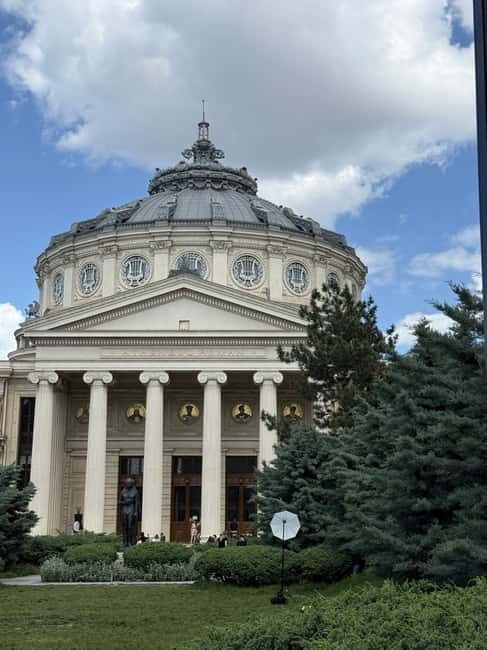
The best way to start at the Romanian Athenaeum is to treat the exterior like a lesson. The façade features six Ionic columns, inspired by ancient Greek temples. Your guide connects those columns to ideas like wisdom and balance, which makes them more than decorative.
Then comes one of the stories that makes this place feel unusually human. You’ll learn about the 19th-century campaign known as Give a leu for the Athenaeum, where everyday people contributed a leu to help build the monument. It’s the kind of national effort that turns a building into a shared project, not a random monument from above.
If you’re someone who likes understanding the “why” before the “wow,” this part pays off fast. Even from the outside, the Athenaeum is already telling you what it wants to be: a cultural temple.
Inside the circular vestibule: marble, light, and the acoustics clue
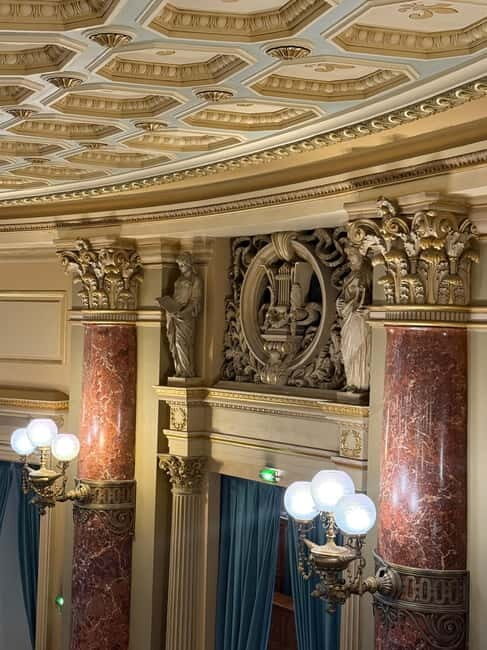
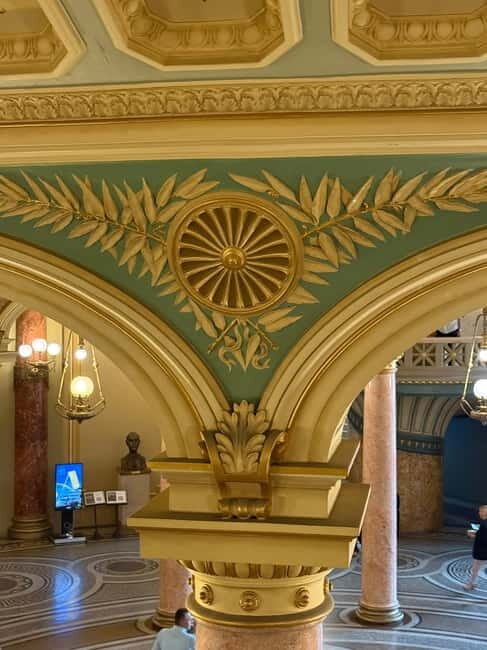
Stepping in, you go from street-level reality into a calmer interior world. The tour moves into a luminous circular vestibule with marble floors and intricate details that make you slow down without being told to.
A major theme your guide will keep returning to is how the building’s shapes are designed to do more than look good. The dome isn’t just a visual centerpiece. You’ll see how it supports the hall’s acoustics, which is one reason musicians love this space.
This is also where you start to feel the Athenaeum as something different from typical tourist attractions. You’re not just viewing art; you’re learning how the space supports music and ceremony.
The horseshoe concert hall: why nearly 800 seats feels intimate
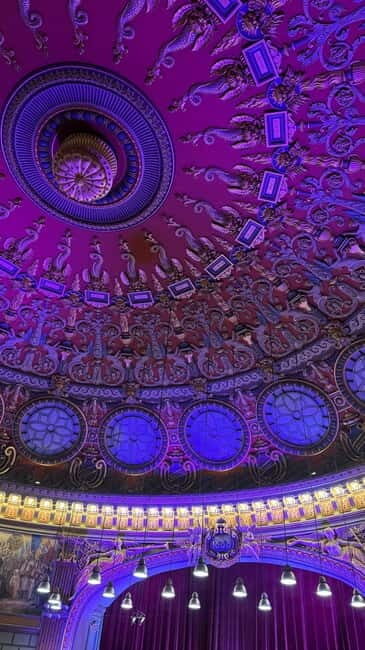
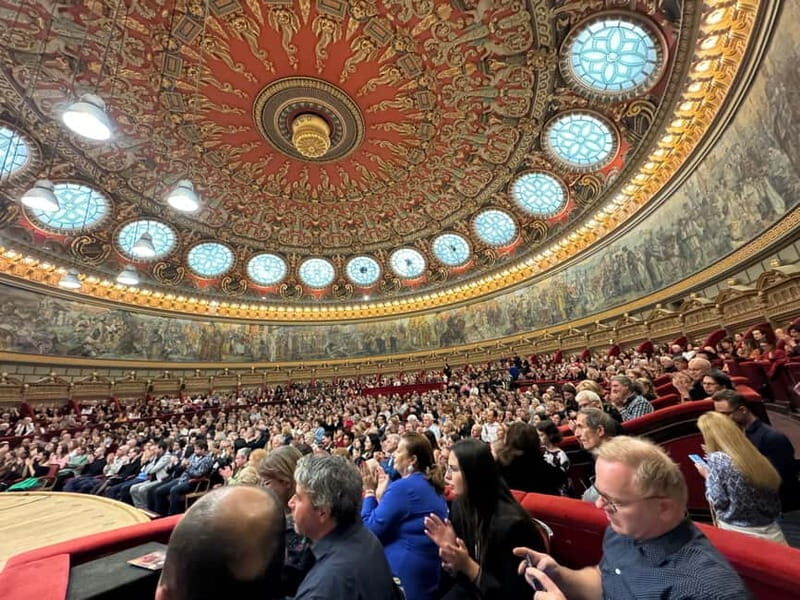
Next you reach the heart of the experience: the concert hall. The auditorium is horseshoe-shaped and designed to seat nearly 800 people, but the geometry is what makes it work. Your guide points out how the architectural harmony supports sound and the way performances fill the room.
This part is a big deal for practical reasons. If you’ve ever been in a concert venue where acoustics feel like a lottery, you’ll appreciate understanding the design choices here. The Athenaeum isn’t loud by accident; it’s shaped to carry music clearly.
If you’re lucky and the schedule cooperates, you may even catch some sound from rehearsals. Some visits include moments like orchestra warm-ups or rehearsals happening nearby, which makes the building’s acoustics feel less theoretical and more physical. Even without that, the tour teaches you what to listen for when you do attend a performance.
Costin Petrescu’s panoramic fresco: Romanian history as a visual map
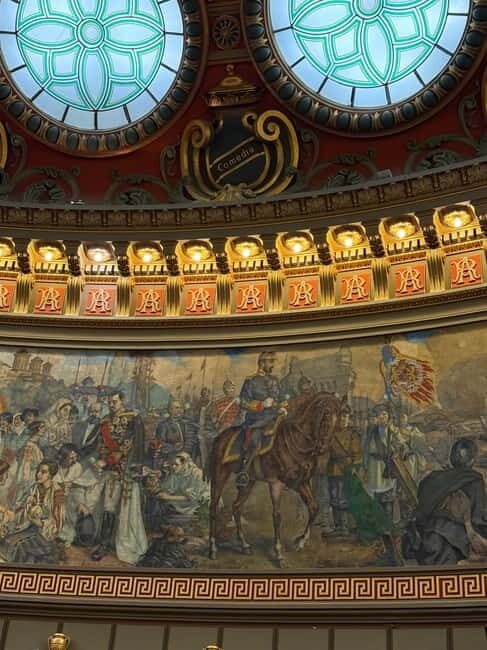
Now for the eye-candy with homework attached. The tour highlights the panoramic fresco by Costin Petrescu, painted in the 1930s. It’s designed to tell the sweeping story of Romanian history through scenes with symbolic meaning.
Your guide explains what you’re looking at, not just what’s painted. The fresco moves through major eras, from the Roman conquest and medieval times to the Great Union of 1918. When you understand the sequence and the symbolism, the fresco stops being a wall painting and becomes a kind of national timeline you can actually read.
This is one of the tour’s biggest strengths: it gives you a framework. Without it, a panoramic work like this can feel overwhelming. With it, you start making connections and noticing details you’d miss on your own.


George Enescu Philharmonic: the Athenaeum as a living cultural machine
The Romanian Athenaeum isn’t a museum frozen in time. It’s tied directly to Romania’s concert life, including its role as home for the George Enescu Philharmonic Orchestra.
Your guide will explain how the Athenaeum became a stage for major cultural events and international performances that shaped artistic life in Romania. The key point for you is that this tour treats the building as a working venue, not a relic.
If you’re planning your Bucharest trip around music, this context helps you decide what kind of night you want next. The tour doesn’t replace a concert, but it does make the hall feel understandable before you sit down.
Extra context you might catch: communism, art changes, and rehearsal moments
Some tours include additional layers beyond the main architecture and fresco. On certain days, Iana may connect the building and Bucharest’s art scene to how culture was affected during the communist period. That kind of context helps you place the Athenaeum inside Romania’s 20th-century story, not only its 19th-century origins.
You might also be able to hear or experience rehearsal activity around the hall. On a couple of visits, people have noted moments like hearing rehearsals for seasonal singing groups. The big catch: it’s not something you should count on like a train schedule. But it’s a nice possibility that makes the tour feel more alive.
Even if none of that happens, the core experience still delivers. The Athenaeum itself gives you enough to chew on.
Photo rules and practical tips for getting your best shots
The good news: you can take photos. The rule is that flash photography isn’t allowed, which makes sense in a place that’s still a performance venue.
For best results, bring a camera you’re comfortable using fast. The most photogenic areas can also be the ones where people naturally slow down, and a 1.5–2 hour tour isn’t long enough for a full-blown studio session.
Also bring comfortable shoes and water. This is a walking-through experience, with enough interior moving that you’ll be happier in supportive footwear than in fashion shoes.
Price and value: what $44 buys (and what it does not)
At $44 per person, this is priced like a focused guided visit, not like a bargain walking tour. Here’s the way I see the value: you’re paying for access to the building with a guide who can explain the symbolism behind the columns, the story behind the fundraising campaign, why the dome matters for acoustics, and how to read Petrescu’s fresco.
You’re also getting a private guided experience (or a small group, depending on what you book). That matters because the guide can point things out in the exact spots where you’d otherwise be guessing. In a venue like the Athenaeum, that guidance is the difference between seeing a pretty building and understanding why it matters.
What this tour doesn’t try to be is a full evening program or a replacement for concert tickets. Think of it as the best pre-show you can buy: you leave with mental bookmark points, so the next time you see music here, you know what you’re looking at.
Who should book this tour (and who might feel rushed)
This is a strong fit if you like architecture, classical music venues, or you want Bucharest beyond its street scenes. It’s also perfect if you enjoy guided interpretation—explaining why a space is shaped a certain way, and not just naming what you see.
It’s also a decent pick for solo travelers who want a local voice and a plan. You’re not left to wander and then wonder what the fresco means.
If you’re traveling with kids, note the tour isn’t suitable for children under 6. And if your travel style is slow and sprawling—half-day museum mode—this might feel like a sprint. Still, the pacing works well for most adults who want a high-impact cultural stop.
Should you book the Romanian Athenaeum guided tour?
Yes, if you want a Bucharest experience that feels cultural and specific. The Romanian Athenaeum is one of the city’s standout symbols, and this guided format helps you connect the outside façade, the inside hall design, and Petrescu’s panoramic fresco into one clear story.
Book it if you care about what buildings mean and you like being guided through details like the Ionic columns, the Give a leu campaign, and the fresco storyline to the George Enescu Philharmonic. If you’re the type who prefers to stare at art without explanations, you might feel you can do this alone—though you’d likely miss the main “how and why” that makes the tour worth the cost.
My practical take: do this earlier in your trip. Then, when you walk or read about Bucharest afterward, the Athenaeum won’t just be a photo you took. It’ll be a place you understand.
FAQ
How long is the Romanian Athenaeum guided tour?
It lasts about 1.5 to 2 hours.
How much does the tour cost?
The price is $44 per person.
Is this tour private or small-group?
It offers private or small-group options.
What languages are available?
The tour is offered in English and Romanian.
Where do I meet the guide?
Meet at the side entrance on the right, beside the front steps of the Romanian Athenaeum. This is the artists’ entrance, and the guide Iana will be waiting outside.
Can I take photos inside?
Yes, photography is allowed without flash.
Is flash photography allowed?
No, flash photography is not allowed.
Who is the tour suitable for?
It is not suitable for children under 6.
What should I bring?
Wear comfortable shoes and bring a camera and water.
Is there free cancellation?
Yes, you can cancel up to 24 hours in advance for a full refund.