REVIEW · BUCHAREST
Bucharest City Tour 2 hours – by Car with a Private Guide
Book on Viator →Operated by Nicolas Experience Tours · Bookable on Viator
Two hours, and Bucharest gets personal. This private, by-car city tour is built for fast understanding: you cover big symbols of Romania’s communist past and its cultural center, with a licensed English guide/driver and pickup so you start smoothly. You get a private car experience instead of squeezing into a group bus.
I especially like that the trip is priced and handled in a straightforward way—car costs, taxes, tolls, and parking are included, with no surprise add-ons during the ride. The main thing to watch is time: at 2 hours, each stop is a highlight pass, not a long museum day, so plan to save deep dives for later.
In This Review
- Key Things I’d Focus On Before You Go
- A 2-Hour Private Drive That’s Built for First-Time Bucharest
- People’s House (Palace of Parliament) and the Weight of Totalitarian Scale
- The National Village Museum: Romanian Homes, Not Just Monuments
- Senate Palace, the Central Committee, and the Starting Point of December 1989
- Ceaușescu Mansion: Private Residence, Public Consequences
- Arc de Triomphe (Romania’s Version): A Freedom Symbol with Four Exhibits
- Romanian Athenaeum: Bucharest Culture in One Flagship Building
- Central Bucharest Sights: Where You’ll Photograph Power, Faith, and Daily Life
- Price and Value: What You’re Really Paying For
- Pickup, Timing, and How to Get the Most Out of Two Hours
- Who This Tour Fits Best
- Should You Book This Bucharest City Tour?
- FAQ
- FAQ
- How long is the Bucharest city tour?
- Is this tour private?
- Is pickup included?
- What language is the guide?
- What does the price include?
- Are food and drinks included?
- Is there a mobile ticket?
- Can I choose a tour time?
- Are group discounts available?
- Can I travel with a service animal?
- What if plans change—can I cancel for free?
Key Things I’d Focus On Before You Go
- Private car for just your group (family/friends), with flexibility on route after starting
- English-speaking licensed guide/driver who keeps the story clear and connected
- People’s House and the Revolution narrative that explains power, propaganda, and aftermath
- National Village Museum for everyday Romanian life through traditional homes and symbols
- Ceaușescu era stops plus the Senate Palace tied to December 1989
- Arc de Triomphe exhibits and Romanian Athenaeum for a strong mix of memory and culture
A 2-Hour Private Drive That’s Built for First-Time Bucharest
If Bucharest is your first stop in Romania (or you only have a small slice of time), this tour makes practical sense. You’re not trying to crisscross the city on your own. Instead, you ride between major sites and get an on-the-spot explanation as you go.
Because it’s a private outing, you can ask questions without a crowd cutting you off. And because the itinerary can be adjusted even after it starts, you’re not stuck with a rigid script if you need to shift the order or spend an extra moment on a particular exterior.
The “private by car” format also matters for the kind of places you’re visiting here. Several stops are best understood from a distance—especially the huge political buildings—before you ever think about going inside later. You get to build the big picture first, then decide what deserves a longer second visit.
You can also read our reviews of more guided tours in Bucharest



People’s House (Palace of Parliament) and the Weight of Totalitarian Scale
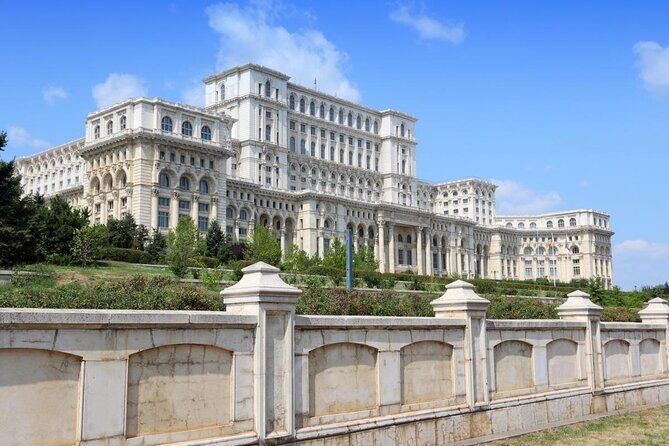
The first major anchor stop is the Palace of Parliament, also called the People’s House. This is the kind of place that hits you even if you didn’t study Romanian history in advance. Your guide frames it as more than impressive architecture. You’re guided toward the point: how totalitarian systems can damage a nation, not just through laws, but through ideology made visible in stone and budget.
What I like about this stop is how it’s explained in plain language: you’re encouraged to notice the size, the opulence, and the megalomania. And you’re not only told what happened—you’re helped to connect why the building symbolizes what a regime did to public life. Seeing the building as a physical statement makes the story easier to remember later.
If you’re the type who likes history with a clear moral and a clear cause-and-effect chain, this is a strong opening. It sets the emotional tone for everything that follows.
The National Village Museum: Romanian Homes, Not Just Monuments
From politics and massive government buildings, the tour shifts to something more human: the National Village Museum. Here, the focus is traditional Romanian life—how people lived, built, and stayed connected to their surroundings.
You’ll see a mix of traditional house styles from different regions. The museum’s strength, as explained on this tour, is that it’s one place where you can compare materials and building methods—wood and adobe, plus stone and other materials—without needing to hop around the countryside.
What you’ll take away isn’t only architecture. You’ll learn how Romanian villagers built in an ecological and sustainable way, right in their own backyards. Even if you only have a short time, that perspective changes how you view “old life.” It stops being vague nostalgia and becomes practical: shelter, community, spiritual symbols, and everyday work.
There’s also a focus on cultural unity through local treasures. You may hear about symbols like mills and wooden churches—small details that help you understand how identity can survive political pressure. This is a great counterbalance after the heavy communism storytelling.
Senate Palace, the Central Committee, and the Starting Point of December 1989
Another key stop is the Senate Palace, described here as a building that once housed the Central Committee of the Romanian Communist Party. Your guide ties this to the Revolution of December 1989, when Nicolae Ceaușescu was removed from power.
This is one of those moments where being inside a car actually helps. You can approach the building with context first, then look at it with new eyes. When you understand what the place represented, the scale and function start to feel like part of the political machinery, not just a backdrop.
If you’re trying to build a timeline in your head—when key decisions were made and where public power concentrated—this stop gives you a useful framework. It’s not just a photo moment. It’s a “now I get why this matters” moment.
Ceaușescu Mansion: Private Residence, Public Consequences
The tour then points you toward the Ceaușescu Mansion—Nicolae and Elena Ceaușescu’s private residence from 1965 to 1989, including their children’s presence as part of the household life.
This stop works because it adds contradiction. You just learned how the regime could damage a nation, and now you’re shown the personal side: the leaders’ private world. That contrast helps you understand why public anger grew. It isn’t abstract; it’s about inequality made visible.
If you care about how dictatorships build comfort for themselves while limiting others, this stop lands well. It gives you a concrete reference point when you later read about the Revolution and the money-and-secrecy controversies mentioned in the tour narrative.
You can also read our reviews of more city tours in Bucharest




Arc de Triomphe (Romania’s Version): A Freedom Symbol with Four Exhibits
Next up is the historical monument inspired by the idea of an arch of triumph. It’s compared to the Arc de Triomphe in Paris, and you’ll hear a useful scale fact: the monument is 27 meters tall, about 16 times the average person’s height.
That size matters, because the tour frames the Arc not just as a landmark, but as a symbol of the fight for freedom—built through change before it reaches the design you see today.
You might also get the chance to see four exhibits:
- The Great War for the Unification of Romania (photography and film)
- The Heraldry of the Great Boyar Families (bronze effigies and photographs)
- The Arch of Triumph in Pictures (photographs and scale models)
- The Great Union of 1918
This is where the tour earns extra points for variety. You’re not only learning about communism and the Revolution. You’re also reminded that Romania’s national story includes earlier unification and identity-building moments. It creates a broader understanding of what “freedom” means across time.
Romanian Athenaeum: Bucharest Culture in One Flagship Building
For a cultural payoff, the tour includes time by the Romanian Athenaeum, described as one of the most representative symbols of Romanian culture and often considered a Bucharest symbol too.
The big practical value here: this building is the kind of landmark you want early in your visit, because it anchors your mental map. Once you’ve seen it in context, everything else in central Bucharest feels more connected.
It’s noted as part of the European Heritage list (le Patrimoine Européen). Even if you don’t track heritage lists while traveling, being told that it’s recognized at this level makes you slow down and look harder at the details.
If you’re not a “museum person” but you still want to feel the soul of a city, this stop can deliver it fast.
Central Bucharest Sights: Where You’ll Photograph Power, Faith, and Daily Life
After the Athenaeum area, the tour’s route focuses on a cluster of central sights that blend culture, fashion, history, and institutions. You’ll pass or stop near major landmarks tied to government power, royal-era presence, museums, churches, and stately buildings.
Among the most emphasized places:
- The Royal Palace
- The Senate Palace (again, tied to the Revolution story)
- The National History Museum, formerly the Post Palace
- The Lady’s Church
- The CEC Palace (CEC headquarters)
- The Palace of the National Military Circle
- Cantacuzino Palace
- The Central University Library
- Plus statues, hotels, restaurants, casinos, and more in the area
This part is especially useful if you love walking later. The tour gives you names and landmarks while you’re already nearby, so you can turn the route into an evening stroll with confidence. You’ll know what you’re looking at and why it matters.
Price and Value: What You’re Really Paying For
At about $123.91 per person for a 2-hour private car tour, the value depends on what you want most: access, comfort, and focused storytelling.
Here’s what makes the price feel more reasonable than a random “see the sights” deal:
- It’s private: your group only, not a shared schedule
- A licensed English-speaking guide/driver is included
- All car expenses are included, including gasoline, parking, and road tolls
- All taxes are included, with no hidden charges noted
- Pickup is offered if you share your time and address
The cost is also easier to justify when you’re traveling with family or friends, because a private car can be good math compared with multiple taxis or long waits between stops.
One more practical note: food and drinks aren’t included. That’s normal for a 2-hour format, but you’ll want to plan where you’ll eat after, especially if you’re doing this early.
Pickup, Timing, and How to Get the Most Out of Two Hours
This tour uses a pickup model, but you need to communicate your pickup time and address. Once that’s set, you’ll have a clear starting point and ride between stops.
You can also choose from different tour times to fit your schedule. That flexibility matters in Bucharest because weather and traffic can shift your day quickly. If you can, pick a time when you’ll still have energy afterward—this route gives you plenty to process, and you’ll probably want a short walk or café break later.
Because you’re in a car most of the time, I’d encourage you to treat it like a guided “city brief.” Look at the landmarks as you pass, take one or two photos per stop (not twenty), and then keep listening. The explanations tie them together.
Who This Tour Fits Best
This is ideal for:
- First-time visitors who want a high-impact overview
- Travelers with limited time who still want meaningful context
- People who prefer private comfort and fewer interruptions
- Anyone interested in Romanian history, especially the communist period and its aftermath
It’s less ideal if you want long museum time at each location. This is a fast, guided loop, not an all-day deep-dive plan.
If you’re returning for a longer stay, this tour is a smart “starter pack.” It gives you the names, the story threads, and the places to revisit with your own pace later.
Should You Book This Bucharest City Tour?
Yes, if your goal is to get oriented quickly and understand the big stories behind the big buildings. The private car setup, the English-speaking licensed guide/driver, and the included car costs make it feel well-run for a short visit. The itinerary also avoids being only political: the Village Museum and Athenaeum keep the balance.
Skip or rethink it if you’re hoping to spend hours inside museums or churches. For that, you’ll want a longer, stop-by-stop plan. But for a concentrated 2-hour introduction with clear storytelling, this is a strong use of time.
FAQ
FAQ
How long is the Bucharest city tour?
The tour is about 2 hours.
Is this tour private?
Yes. It’s a private tour, and only your group participates.
Is pickup included?
Pickup is offered. You’ll need to provide your pickup time and address.
What language is the guide?
The tour includes a private, licensed English-speaking guide/driver.
What does the price include?
Car expenses like gasoline, parking, and road tolls are included, as well as taxes. The private car is also included.
Are food and drinks included?
No. Food and drinks are not included.
Is there a mobile ticket?
Yes, a mobile ticket is included.
Can I choose a tour time?
Yes. You can choose from different tour times to fit your schedule.
Are group discounts available?
Group discounts are listed as available.
Can I travel with a service animal?
Service animals are allowed.
What if plans change—can I cancel for free?
Free cancellation is offered up to 24 hours in advance for a full refund.