REVIEW · BUCHAREST
Tuk Tuk Bucharest Private Tour – Unique Experience.
Book on Viator →Operated by Tuk Tuk Bucharest Tours · Bookable on Viator
Bucharest at night, powered by a tuk-tuk. This private ride is built for people who want the big sights fast, with photo stops for major landmarks and a clear thread through the city’s communist-era story. You also get to customize the route, so it feels less like a fixed bus loop and more like you’re steering the evening.
I especially like two things: the low-stress way you cover the city, and the comfort extras that make the ride pleasant even when the weather turns. The tuk-tuk setup helps you get photos without the usual window-glare issues, and the guide’s commentary adds context while you’re moving. It’s also practical that some stops are free, so you can keep your budget steady.
One drawback to think about: time is tight at most stops (often just 5 minutes), so this is best for seeing and learning rather than doing long museum visits. Also, the experience needs good weather to run, so plan a flexible evening if your trip dates are weather-sensitive.
In This Review
- Key highlights to know before you go
- Tuk-tuk touring at night: why this style works
- Price and value: what $84.10 buys you
- How the pickup and timing affect your experience
- Palatul CEC: the first photo stop with serious presence
- The National Museum of Romanian History: quick context right next door
- Palace of Parliament: the biggest photo stop (and the best one)
- Water Symphony fountains and the communist-era main artery
- The oldest hospital in Bucharest (built 1704)
- University’s Square: churches, theaters, and academic energy
- The mayor’s cabinet building and views toward Cismigiu Gardens
- Ateneul Roman: a musical landmark that changes the mood
- Revolution Square: where the story turns
- Triumph Arch and Dorobanți: photo control, then a change of class
- What makes the guides so effective on this ride
- The amenities list that actually helps (blankets, umbrellas, snacks)
- Who this tour is best for
- Choosing the best time slot: evening beats the grind
- Should you book the Tuk Tuk Bucharest Private Tour?
- FAQ
- How long is the Tuk Tuk Bucharest Private Tour?
- What does the tour cost?
- Where do we meet, and is pickup available?
- Is this a private tour?
- Is the tour offered in English?
- Are admission tickets included for the stops?
Key highlights to know before you go
- Private and customizable: choose where you go within the tour flow instead of getting locked into one script
- Night-focused sightseeing: built for evening viewing, with photo stops that work well in low light
- Comfort on board: blankets, umbrellas, and snacks help you stay warm and ready
- Quick photo stops: major landmarks in less walking time, with short holds for pictures
- Communist-era storyline: the route connects multiple landmarks tied to Bucharest’s 20th-century history
- Photo-friendly vehicle: the tuk-tuk setup makes it easier to take clean shots without fighting glare
Tuk-tuk touring at night: why this style works
If you’ve ever tried to “see everything” on foot in Bucharest, you know how quickly it turns into stop-and-go fatigue. This tour tackles that head-on. You get around the core sights with minimal walking, which matters most when roads are busy or you’re arriving after a long travel day.
The night angle is also a big deal. You get the lights, the easier pace, and a better feel for wide boulevards and monumental architecture. It’s a smarter way to get your bearings fast, especially if this is your first evening in town.
And yes, it’s fun. A tuk-tuk ride is inherently more playful than a standard tour vehicle, but it’s not just about the novelty. The whole point is getting you close enough to key landmarks for photos, while your guide ties it together with stories you can actually use as context for the rest of your trip.
You can also read our reviews of more private tours in Bucharest

Price and value: what $84.10 buys you
At $84.10 per person for about 1 to 2 hours, you’re paying for three things: private time, a vehicle that reduces walking, and guided interpretation that helps the sights make sense.
For me, the best value comes from the way the route packs in stops that many first-time visitors struggle to connect. You’re not just collecting photos. You’re seeing how different parts of the city relate to one another—banks and museums, major political architecture, commemorative squares, and a high-end neighborhood—all in one outing.
The other value factor is convenience. Pickup is offered from downtown hotels/addresses, and the tour ends back at the meeting point. That reduces the “how do we get there” headache and lets you stay focused on the sites.
If you’re the type who wants to linger inside museums or churches for long stretches, this price may feel “short.” If you want orientation, stories, and photos with minimal walking, it’s a solid use of time.
How the pickup and timing affect your experience
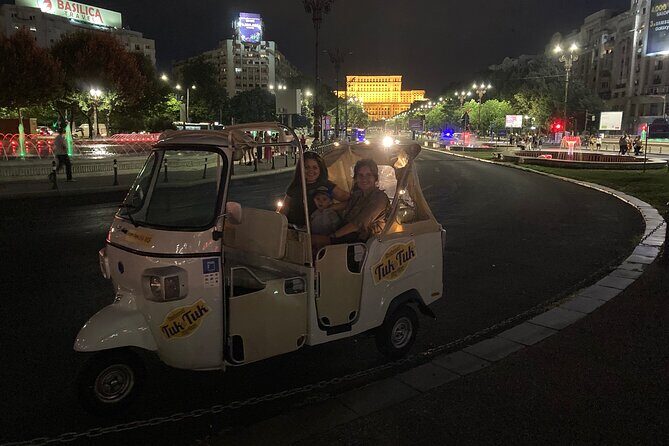
You start at Strada Doamnei 8 (right by the National Bank of Romania area, next to the Hilton Garden Inn Old Town). Free pickup is available from any hotel/address in the downtown area, and the experience returns you back to the starting point.
This matters because Bucharest can be easiest when you avoid logistical friction. With pickup, you don’t need to plan transit for a short, high-impact tour.
Time-wise, you should expect the tour to move steadily. Many stops are listed as around 5 minutes, with a couple of longer holds. That’s enough for photos and quick orientation, but not enough for deep inside-the-building visits at every stop.
Palatul CEC: the first photo stop with serious presence
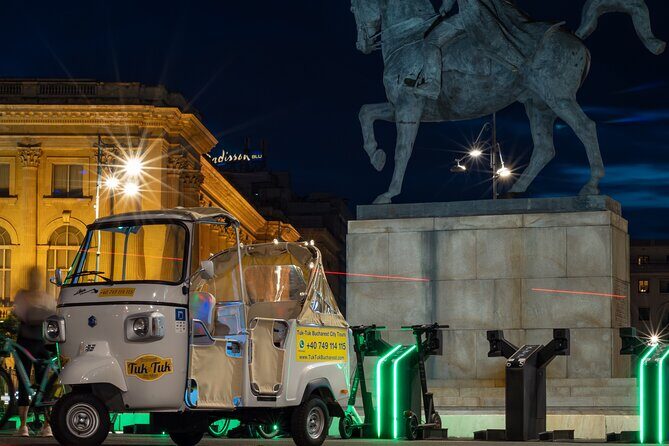
The tour begins with Palatul CEC, the iconic building tied to the first Bank of Romania. This is the kind of stop that works even if you’re not sure what you’re looking at yet. The architecture is bold, and your guide uses that first landmark to set the tone for the city’s older layers.
At about 5 minutes, the goal here isn’t to read every detail. It’s to give you a visual anchor. If you take photos, this is a nice early point—before the evening gets busy and before you’re fully warmed up to the rhythm of the tour.
Admission is not included for this stop, so think of it as a photo-orientation stop unless you plan extra time separately.
The National Museum of Romanian History: quick context right next door
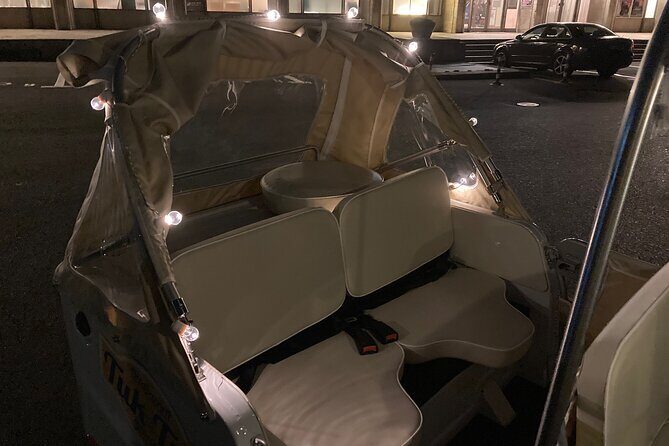
Right in front of the CEC Palace is the National Museum of Romanian History, inaugurated in 1972 and located in the Old Historical Centre area. Since it’s such a close neighbor, it fits perfectly into the “see more with less walking” idea.
You’ll get a short look (again, about 5 minutes). That’s ideal if you want the museum as a mental bookmark for later, or if you’re hoping to decide whether to come back for an interior visit.
Admission is not included here, so if museum time is a priority for you, plan to treat this stop as an introduction rather than the full experience.



Palace of Parliament: the biggest photo stop (and the best one)
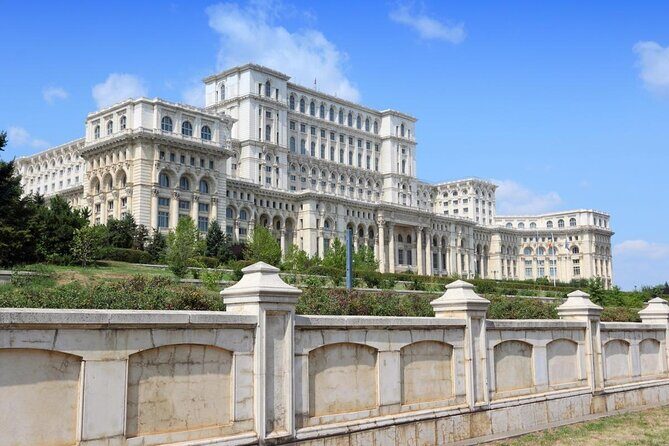
The Palace of Parliament is the second big photo stop and is often described as the standout. Even from outside, it’s the kind of structure that demands attention. It’s closely linked to the way communist Romania left its mark on city space.
This hold is about 5 minutes, which may sound quick. But for this particular building, that’s often enough to appreciate scale and grab photos before you move on. If you’re expecting a long visit inside, that’s not what this tour is designed for.
Admission is not included, so consider the palace here as part of the guided story—how the city’s political weight shows up in stone, roads, and public space.
Water Symphony fountains and the communist-era main artery

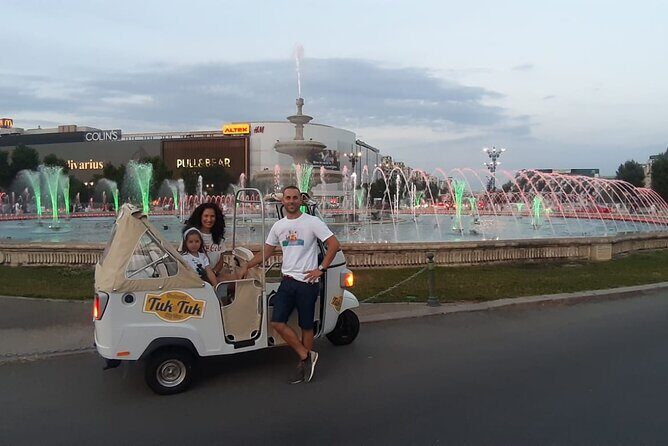
One of the most interesting parts of this route is the focus on the Water Symphony fountains show (noted as a great summer show). If you’re traveling in warm months, this is where the tour turns from pure sightseeing into something closer to spectacle.
The tour also references the city’s main artery as the communist-era answer to Paris’s Avenue des Champs-Élysées—longer and wider than Paris’s boulevard, and a central stage for the Water Symphony show. That comparison gives you a mental model: a grand, designed-for-visibility corridor where big public moments were meant to happen.
Because this is a guided photo-stop style tour, you’re not being asked to spend long hours waiting. You get to see how these spaces function and why they matter in the city’s 20th-century narrative.
A small practical note: since this is tied to seasonal conditions (the show is specifically called out for summer), check your timing. If you’re not in summer, you still get the urban story, but the full show impact might be limited.
The oldest hospital in Bucharest (built 1704)

Another quick stop brings you to the oldest hospital in Bucharest, built in 1704. This is a good palate-cleanser after the heavy political landmarks.
It also helps your guide’s bigger theme: Bucharest isn’t only 20th-century architecture. It layers older institutions beside newer political power, and seeing them near each other gives you a more complete sense of continuity rather than a single-theme city.
The tour framing here is short and visual, so treat it like a landmark moment. If you’re a “I need to go inside” type, you’ll likely want to research additional visits separately.
University’s Square: churches, theaters, and academic energy
University’s Square is one of the stops where the tour gets especially useful for orientation. It includes the Coltei Church, the Ministry of Agriculture Palace, the Sutu Mansion (Museum of Bucharest), the National Theater, and the University of Bucharest.
You’ll have about 5 minutes for this cluster. That’s plenty to get a sense of why this intersection matters: it gathers religious, cultural, government, and education landmarks into one concentrated zone.
The stop is noted as free, which is great if you’re trying to keep costs predictable. Even without museum entry time, the variety of buildings gives you a strong “map in your head” for where to walk later (if you choose to).
The mayor’s cabinet building and views toward Cismigiu Gardens
Inside this same University’s Square area, you’ll see the building that houses the cabinet of the mayor of Bucharest. It’s described as using Neo-Romanian style and overlooking Cismigiu Gardens.
This is the kind of stop that’s worth listening for. A short visual moment turns more meaningful when you understand what kind of political power sits behind the façade—and how city planning pulls green space into view.
Again, it’s short (about the stop duration), so focus on photos and big-picture understanding rather than expecting a deep guided walk.
Ateneul Roman: a musical landmark that changes the mood
Next is Ateneul Roman, an iconic concert hall built in 1888 by public subscription. It’s also home to the International Classical Music Festival “George Enescu.”
This stop adds a different tone. After political and commemorative sites, Ateneul Roman makes the evening feel like Bucharest isn’t only about state power—it’s also about culture that outlasts regimes.
Admission is not included here, but the architectural impact outside is often enough for a photo-and-context moment. If you’re a classical music fan, this is a stop that can spark ideas for a future evening concert, even if you don’t plan one now.
Revolution Square: where the story turns
Revolution Square is one of the emotional anchors of the route, and the stop is listed as around 10 minutes. This is described as the place where the end of communism happened in December 1989.
This is where the guide’s pacing matters. In a short tour format, you still want a moment to let the significance land. The extra time here compared to 5-minute stops gives you that breathing space.
The stop is free, so you can focus on learning and photos without budgeting entry fees for this part of the narrative.
Triumph Arch and Dorobanți: photo control, then a change of class
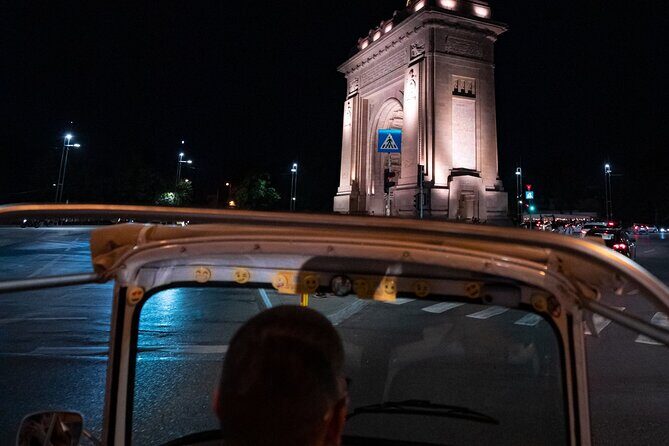
The tour continues with a stop by Triumph Arch (Arcul de Triumf). The setup is practical: your vehicle can stop where other vehicles can’t, which means you get better photo opportunities. You can either go around or stay underneath for pictures, with about 5 minutes.
Then there’s Dorobanți, described as Bucharest’s most exclusive neighborhood, filled with older villas and varied architecture. You’ll have around 10 minutes here, and it’s free.
This shift is useful. After the heavy communist-era and revolution-focused segments, Dorobanți gives you a contrast—wealth, different streetscapes, and a more relaxed feel. It’s also a reminder that Bucharest history doesn’t run in a straight line. Different eras leave different neighborhoods, and you can feel the change even within one evening.
What makes the guides so effective on this ride
The strongest feedback I saw in the overall experience centers on the guides themselves—especially Robert and Valentin, with Alan also mentioned. What comes through is the combination of professionalism, friendliness, and clear communication.
A few practical things matter on a city vehicle tour:
- They plan pickup timing and keep you informed.
- They answer questions as you pass each landmark, not just as a one-way lecture.
- They drive confidently even with busy traffic, so you don’t spend your energy worrying.
One review detail worth taking seriously: many people mention that photo stops work well because the vehicle setup helps reduce window glare, and you can jump in and out easily when it’s time for quick shots.
That’s not a small perk. In a tour where most stops are short, photo clarity and quick access can make the difference between getting a few decent images and getting a set you actually want to keep.
The amenities list that actually helps (blankets, umbrellas, snacks)
The tour provides blankets, umbrellas, and snacks, plus it’s described as offering water in at least some situations. Those sound like little extras until you’re out at night or in shoulder seasons.
I like this approach because it’s not asking you to guess what you’ll need. If you’re visiting in fall or shoulder weather, a blanket can turn a “cold ride” into a comfortable one. If there’s a quick shower risk, an umbrella saves time and stress.
It also supports the tour’s basic promise: less walking, more staying comfortable, and still seeing the city without feeling rushed by discomfort.
Who this tour is best for
This is a great fit if you:
- Want a high-impact overview without hours of walking
- Like guided context that helps connect landmarks
- Prefer a private format where you can ask questions and adjust the flow
- Are traveling with someone who has limited mobility for long sightseeing days (you’re still outside, but walking is reduced)
It might be less ideal if you:
- Want to spend most of your time inside major museums or the Parliament
- Don’t like short stops and photo moments
- Need long, quiet time at each site
Choosing the best time slot: evening beats the grind
If you can, I’d aim for a later start. Even when the day is warm, evening tends to feel easier for long outdoor sightlines. The tour also lines up with major attractions where light and night ambiance make photos look better.
And if you’re traveling in summer, the connection to the Water Symphony show is a strong reason to pick an evening slot that matches the season.
Should you book the Tuk Tuk Bucharest Private Tour?
Yes—if you want an efficient, fun way to learn Bucharest while still seeing the big-ticket landmarks. The combination of a private, customizable route, short photo stops at major sites, and provided comfort items makes this a practical first-night (or first-quick-day) strategy.
I’d especially recommend it if you value strong guiding and smooth logistics. When guides like Robert or Valentin are doing the driving and the storytelling, you end up with both motion and meaning, without spending your evening stuck in a long walking loop.
FAQ
How long is the Tuk Tuk Bucharest Private Tour?
It runs about 1 to 2 hours (approx.).
What does the tour cost?
The price is $84.10 per person.
Where do we meet, and is pickup available?
The meeting point is Strada Doamnei 8, Bucharest 030167, Romania, in front of the National Bank of Romania. Free pickup is offered from any hotel/address in the downtown area, and the tour ends back at the meeting point.
Is this a private tour?
Yes. It’s private, and only your group participates.
Is the tour offered in English?
Yes, it is offered in English.
Are admission tickets included for the stops?
Not always. Some stops list admission ticket not included (for example Palatul CEC, the National Museum of Romanian History, the Palace of Parliament, and Ateneul Roman), while other stops are listed as free (such as University’s Square, Revolution Square, and Triumph Arch).